

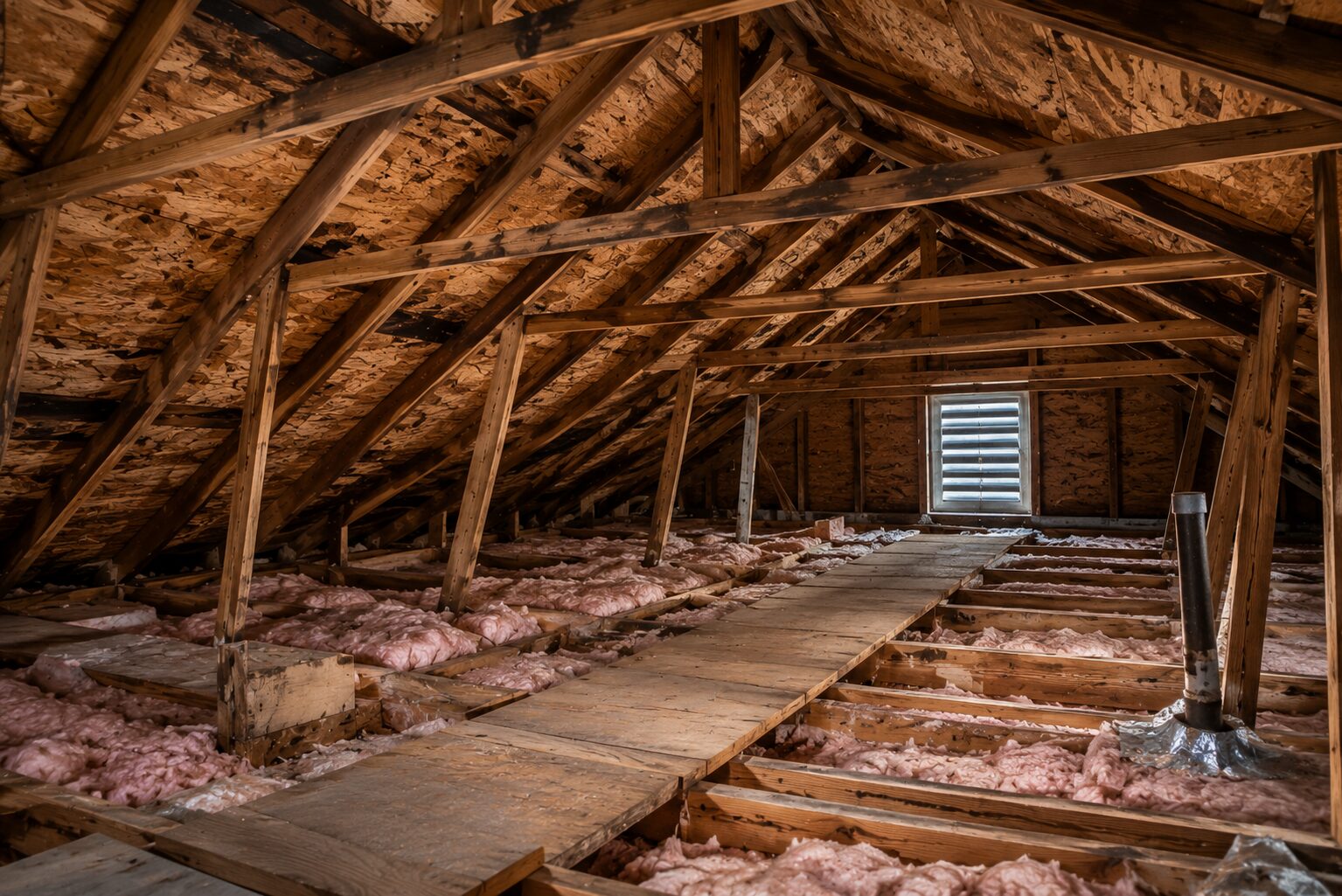
If your roof is 15 years old or older, a surface inspection may not tell the whole story. Our Houston roofing team performs comprehensive attic and roof inspections to identify decking damage, ventilation issues, structural concerns, and signs of premature roof failure.
Schedule your free roof inspection today.
When a homeowner calls us out to assess an aging roof, the conversation rarely stays on just the shingles. Roofs don’t fail in isolation — they’re connected to attic ventilation, structural integrity, and the condition of everything underneath the surface. This post walks through a real roof inspection Houston homeowners can learn from: a mixed-age home where the visible exterior told one story, and the attic told a completely different one.
No client names. Just the findings, the decisions, and what they mean for your roof.
The House: A Roof Nearing the End of Its Lifespan
The property was a one-story Houston home with an original structure dating to the early 1900s, with an addition and garage built around 2006. The roof was installed around the same time as the addition — making it approximately 20 years old at the time of our visit.
The homeowner had moved in about four years earlier. At that point, two separate contractors had patched leaks at several penetrations and given the roof roughly five years of life remaining. Those five years were up.
This is a pattern we see regularly when performing roof inspections in Houston: a homeowner who inherited an aging roof, made reasonable repairs along the way, and is now facing the real question — when to replace a roof, not just patch it again.
The roof showed several old roof warning signs from the street: minor granule loss, a few lifted shingles at the rake edges, some discoloration near the valleys. Concerning, but not dramatic. The real picture was inside the attic.
Why We Always Start in the Attic
Most roof inspections begin on the roof. Ours begin underneath it.
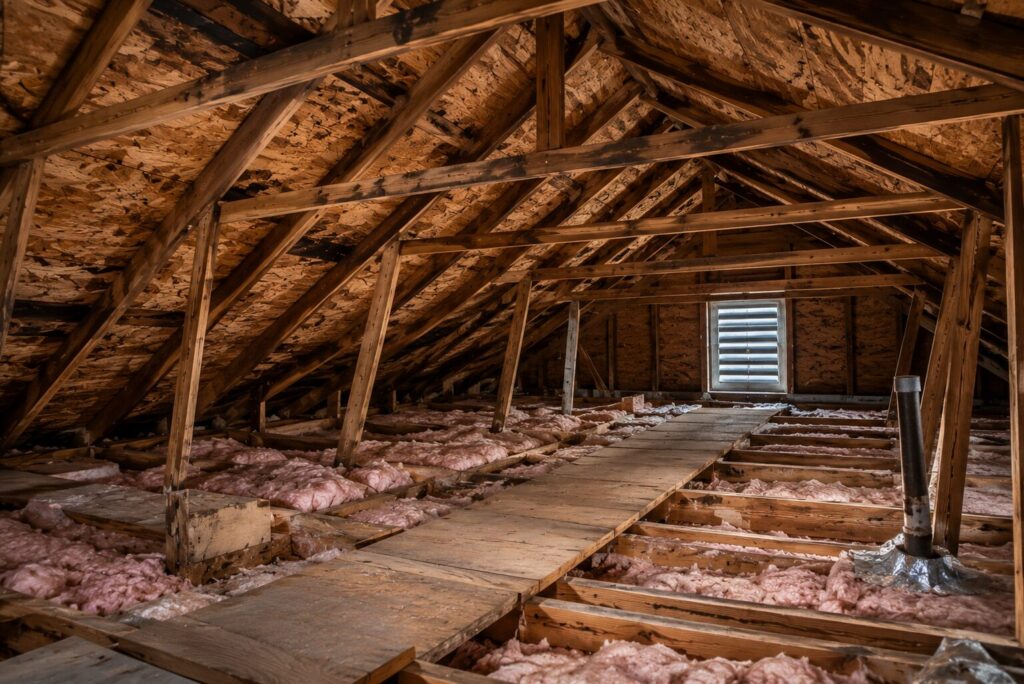
The attic is where a roof’s true condition lives. The shingle surface tells you what the weather has done. An attic roof inspection tells you what years of heat, humidity, and roof ventilation problems have done to the structure those shingles are sitting on.
If a Houston roofing contractor isn’t going into the attic before giving you a quote, they’re giving you an incomplete picture. The attic inspection is what separates a surface-level assessment from a structural one — and it’s the step that most often changes the recommendation.
On this job, the attic told us a great deal.
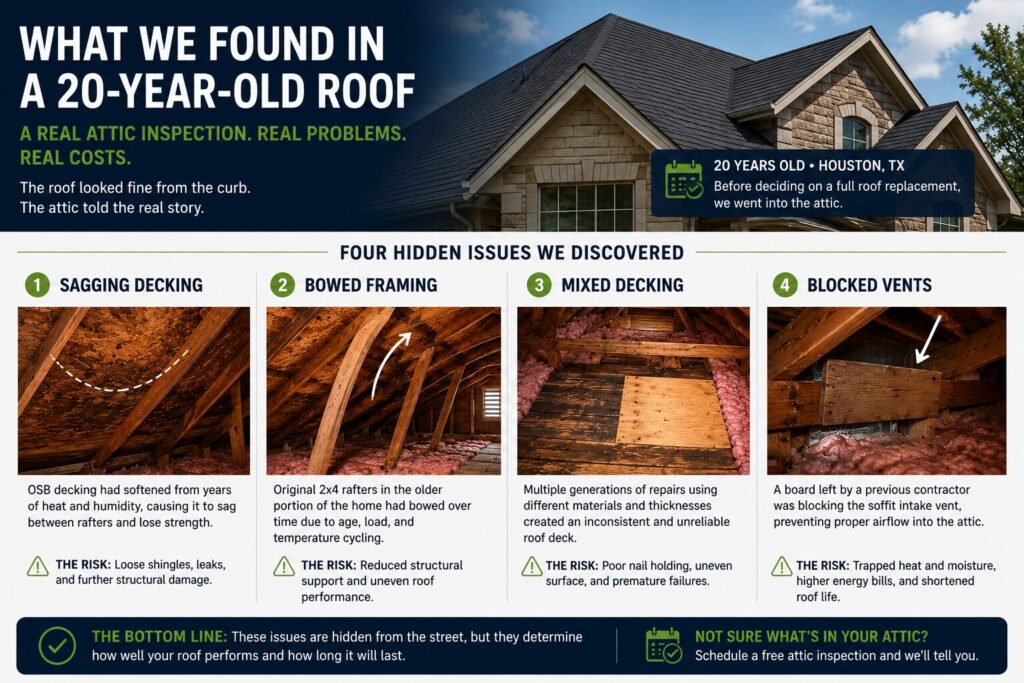
What We Found During the Inspection
Sagging Roof Decking
In two distinct areas of the original section of the home, the OSB decking — the boards that sit between the rafters and directly under the shingles — had softened and begun to sag. Sagging roof decking is one of the clearest signs of long-term moisture and heat exposure. Once OSB loses its rigidity, it begins to lose its ability to hold fasteners.
When decking goes soft, nails lose their grip. When nails lose their grip, shingles lift. When shingles lift, water gets in. The progression is slow, invisible from the street, and almost always misdiagnosed as a shingle problem on a surface-only inspection.
Roof decking damage at this stage is not a cosmetic issue — it is a structural one. No amount of new shingles on top of failing decking will produce a roof with a predictable lifespan.
Bowed Roof Framing
Some of the original framing in the older section of the house was built with two-by-fours. Modern building code requires two-by-sixes or larger for roof rafters — and for good reason. Over a century of load, settlement, and Houston temperature cycling, several of those original rafters had bowed.
This isn’t a reason to panic. It is a reason to know about it before investing in a roof replacement in Houston. A new roof installed on compromised framing without addressing the structural issues will underperform and may create warranty complications.
Mixed Decking Materials
Over the decades, various contractors had patched sections of the decking with new plywood laid over original plank decking. The result was an inconsistent substrate — different thicknesses, different materials, different nail-holding capacity — across the same roof plane.
This is one of the subtler aging roof signs, and one that’s only visible from the attic. A new roof installation on top of mixed, inconsistent decking requires careful preparation before a single shingle goes down. Skip that step, and premature failure is predictable.
Blocked Intake Vents
The finding that surprised the homeowner most: the intake vents at the soffit level were physically blocked. A board left in place by a previous contractor was preventing air from entering the attic entirely.
Roof ventilation problems like this one are extremely common in Houston — and extremely consequential. Proper attic ventilation requires balanced airflow: air coming in at the low points (intake) and air leaving at the ridge (exhaust). Without intake air, hot humid air sits in the attic with nowhere to go. Attic temperatures in Houston summers can reach 140–150°F under these conditions.
That heat degrades shingles from below, accelerating granule loss and cracking. It softens the OSB decking. It forces your AC to work harder. And it silently shortens the life of everything in the attic — including the new roof you’re considering putting on top of it.
Addressing roof ventilation problems isn’t a separate project from roof replacement — it’s part of the same scope, and it has to happen before the new roof goes on.
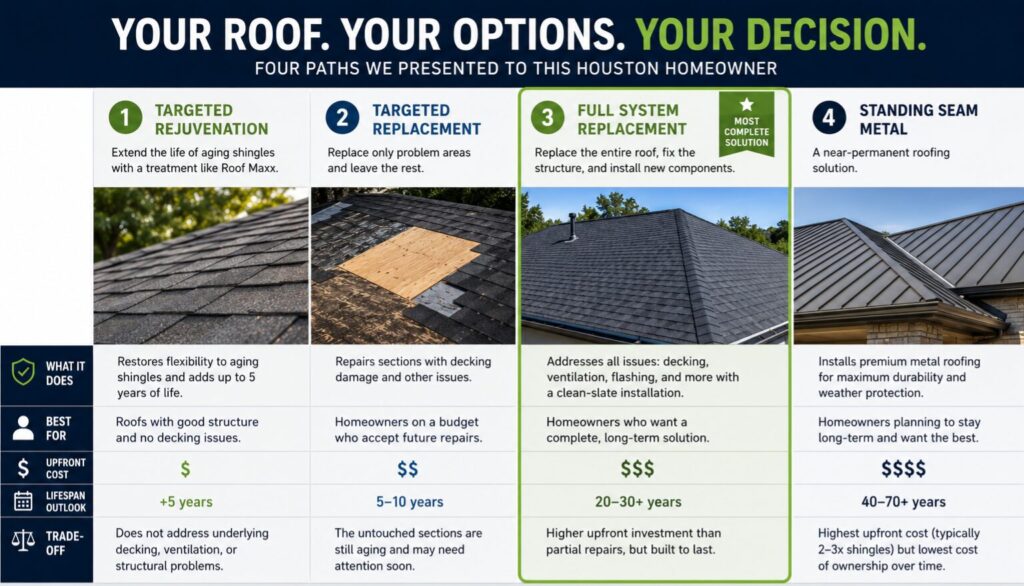
The Four Roofing Options We Presented
After completing the attic roof inspection, we walked the homeowner through four options. This is how we approach every aging roof assessment: the right answer depends entirely on the homeowner’s timeline, budget, and what the inspection actually found — not on what’s easiest to quote.
Option 1 — Targeted rejuvenation
A bio-based treatment like Roof Rejuvenate USA can restore flexibility to aging asphalt shingles, extending roof life by approximately 5 years on a roof with sound structural integrity. This was not appropriate here — the sagging roof decking meant the substrate wasn’t sound enough to justify treatment.
Option 2 — Targeted replacement
Replace only the sections with confirmed roof decking damage, repair the ventilation, and leave the sound sections in place. Lower upfront cost, but the homeowner accepts that the remaining sections continue aging and may need attention within a few years.
Option 3 — Full system replacement
Replace the entire roof, correct all decking issues, balance the ventilation, and install new pipe boots and flashing throughout. This is the clean-slate option — the one that addresses every finding from the inspection in a single scope. For this home, with multiple compounding issues, this was the most predictable long-term path.
Option 4 — Standing seam metal
Higher upfront investment — typically 2–3x the cost of architectural shingles — but a near-permanent solution. For a homeowner planning to stay in the house long-term, the total cost of roof replacement in Houston over 50 years often favors metal, especially as roofing costs continue to rise.
We presented all four options with honest tradeoffs. The homeowner chose Option 3. That’s not always the outcome — and it doesn’t need to be. The goal is an informed decision, not a sale.
What These Findings Mean for Your Roof
If your home is over 15 years old — or if you bought a home and inherited someone else’s roof — here are the things worth knowing before your next inspection or quote:
The attic comes first. Any inspection that doesn’t include time in the attic is a surface assessment, not a structural one. Ask your Houston roofing contractor explicitly: “Are you going into the attic?” If the answer is no, you’re getting an incomplete picture.
Know the aging roof signs. Patching leaks two or three times in five years is a signal, not a solution. Repeated repairs are treating symptoms while the underlying cause — roof decking damage, roof ventilation problems, compromised framing — continues. The repairs buy time. They don’t stop the clock.
Roof ventilation problems are part of the roofing conversation. Blocked or unbalanced ventilation affects your energy bills, your insulation performance, your shingle lifespan, and the structural integrity of your decking. Every roof replacement in Houston should include a ventilation assessment and correction as part of the scope — not as an upsell.
Understand when to replace a roof vs. when to repair. The answer depends on three things: decking condition, ventilation status, and how long you plan to stay. A contractor who gives you a recommendation without checking all three is guessing.
Schedule a Free Roof Inspection in Houston
If your roof is approaching 15–20 years, if you’ve had repeated repairs, or if you want to know what’s actually happening before the next Houston storm season, a comprehensive attic and roof inspection is the right first step.
We go into the attic on every inspection, check the decking, assess the ventilation balance, and give you a straight answer — no pressure, no manufactured urgency.
We also understand that a roof replacement is a significant investment, and timing isn’t always ideal. That’s why we offer flexible financing options for qualified homeowners — so a 20-year-old roof with real problems doesn’t have to wait until the ceiling gets wet. If cost is part of the conversation, ask us about financing when you book. We’ll walk you through what’s available alongside the inspection findings.
Know What’s Really Happening Under Your Roof.
Frequently Asked Questions About 20-Year-Old Roofs
How long should a roof last in Houston? Most asphalt shingle roofs in Houston last 15–25 years depending on ventilation, installation quality, and storm exposure. Roofs with poor attic ventilation or unresolved decking issues often fail earlier — sometimes significantly so. Standing seam metal roofs can last 50+ years with proper installation.
Can a 20-year-old roof be repaired instead of replaced? Sometimes. If the decking and framing remain structurally sound and the ventilation is balanced, targeted repairs or rejuvenation treatments may extend the roof’s life by several years. If sagging roof decking, bowed framing, or blocked intake vents are present, repair alone is unlikely to produce a predictable lifespan — and a full replacement is usually the more cost-effective decision over time.
What are signs that roof decking is failing?
- Sagging roof sections visible from the attic or exterior
- Soft decking that compresses underfoot when walking the roof
- Loose or lifting shingles without obvious wind damage
- Repeated leaks at the same locations despite prior repairs
- Visible moisture staining or mold on attic sheathing
Any one of these warrants an attic inspection by a qualified Houston roofing contractor before making any repair or replacement decision.
Why is attic ventilation important? Proper attic ventilation reduces heat buildup that degrades shingles and softens decking, prevents moisture accumulation that leads to mold and structural damage, extends overall roof lifespan, and improves energy efficiency by reducing the load on your cooling system. In Houston’s climate, where attics can reach 140–150°F in summer without adequate airflow, ventilation is one of the highest-impact factors in how long a roof lasts.
Kainos serves Houston and surrounding areas. We specialize in roofing, windows, and exterior systems for residential homes.
Leave a Reply